
Comparing Crawl Space Quotes in 2026: What AL, SC, NC, GA, TN and VA Homeowners Should Ask
Reviewed: October 1, 2026. Tennessee guidance added October 4, 2026. Alabama and Virginia guidance added October 8, 2026. A crawl-space estimate can be precise about the price and vague about the problem. Two companies may inspect the same house, recommend different systems and each call the result ‘encapsulation.’ The homeowner is then left trying to compare totals for work that may have little in common. Start with one question: after this work is finished, which of the problems found at my house will still need attention? Ask each company to put its answer in writing. Then compare the evidence, the work included, the exclusions and the responsibilities you will inherit. The printable companion worksheet helps you do that with up to three quotes. It includes space for unresolved work and recurring costs, so a missing answer stays visible instead of disappearing into a package price. Download the printable crawl-space quote comparison worksheet (PDF, 4 pages)Quick comparison table
Prefer to work on this page? Use these questions beside up to three proposals, or download the detailed PDF above. This table does not save or submit your answers.
Compare up to three written quotes
Print this worksheet or use it alongside your written proposals. Blank cells are for your notes. The site does not collect or save anything you write on a printed copy.
| Compare this | Company 1 | Company 2 | Company 3 |
|---|---|---|---|
| Problem and inspection evidence | ________________ | ________________ | ________________ |
| Cause and diagnosis | ________________ | ________________ | ________________ |
| Preparation, removal and disposal | ________________ | ________________ | ________________ |
| Materials, specifications and quantity | ________________ | ________________ | ________________ |
| Site-specific requirements and disposal | ________________ | ________________ | ________________ |
| Equipment and electrical work | ________________ | ________________ | ________________ |
| Permits and inspections: who is responsible? | ________________ | ________________ | ________________ |
| Exclusions and possible change orders | ________________ | ________________ | ________________ |
| Total price, payment schedule and financing cost | ________________ | ________________ | ________________ |
| Warranty coverage, exclusions and transfer terms | ________________ | ________________ | ________________ |
| Maintenance and follow-up | ________________ | ________________ | ________________ |
| Coverage, scheduling and project contact | ________________ | ________________ | ________________ |
Before deciding: resolve differences in scope, verify current insurance and applicable qualifications directly, and read the actual contract and warranty. The lowest price alone does not establish the best fit.
Compare crawl-space quotes at a glance
Make the scope clear before comparing totals. Use these five questions alongside the printable comparison worksheet above.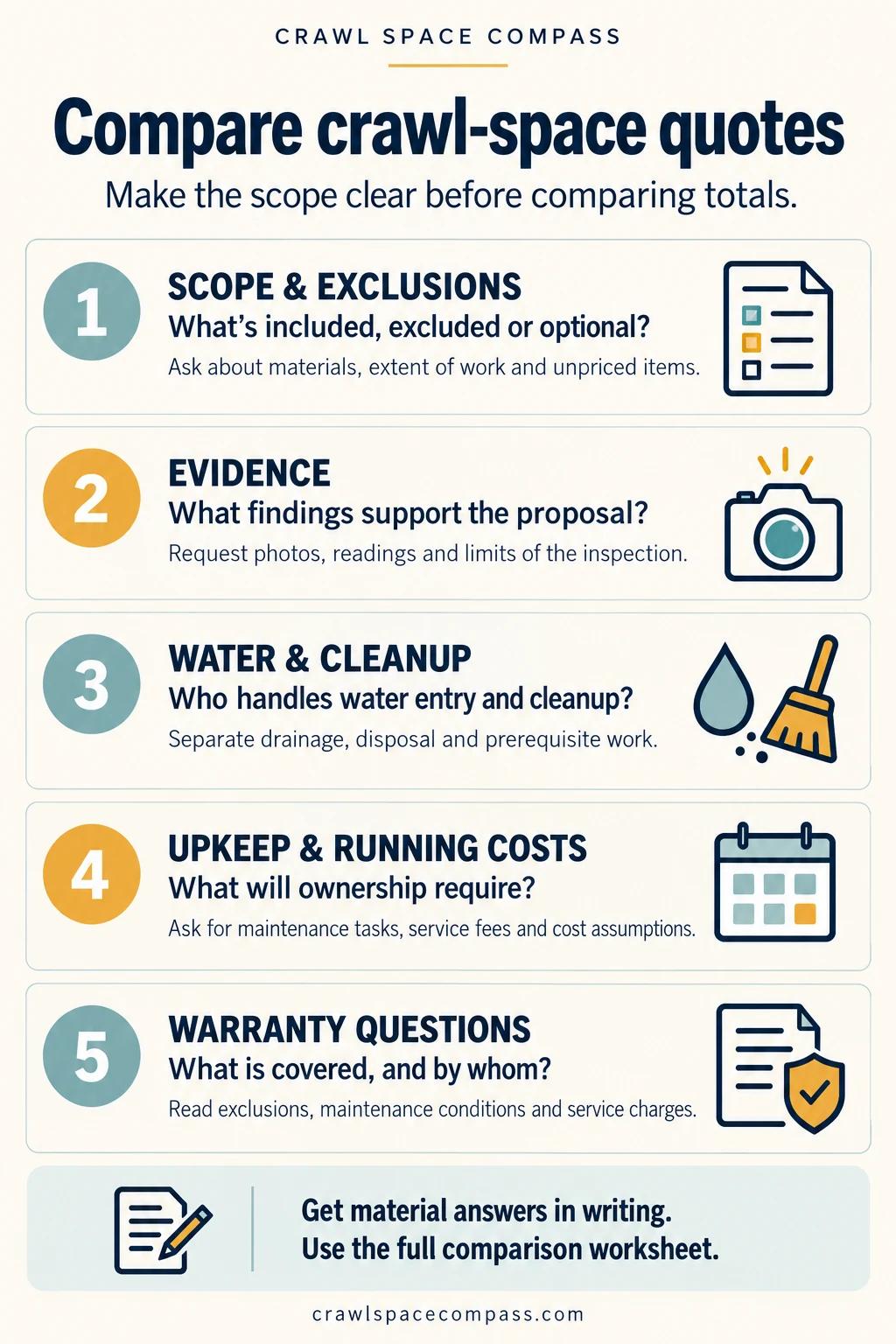
Text version: five questions for every quote
- Scope and exclusions: What's included, excluded or optional? Ask about materials, extent of work and unpriced items.
- Evidence: What findings support the proposal? Request photos, readings and limits of the inspection.
- Water and cleanup: Who handles water entry and cleanup? Separate drainage, disposal and prerequisite work.
- Upkeep and running costs: What will ownership require? Ask for maintenance tasks, service fees and cost assumptions.
- Warranty questions: What is covered, and by whom? Read exclusions, maintenance conditions and service charges.
Give each line item a clear status
Copy the same categories into every quote comparison. For each category, use one of these five statuses:- Included: the written quote identifies the work, its extent and the relevant materials or equipment.
- Excluded: the contractor has specifically left it out. Record who will do it, when and for what price if it is needed.
- Optional: it has a separate price, and you understand whether it is an upgrade or an alternative to other work.
- Unclear: the quote does not establish what happens. Ask a question rather than treating silence as inclusion.
- Not needed: the contractor has explained why the work is unnecessary for this house. Keep that explanation with the quote.
A worked example of two incomplete quotes
Consider this hypothetical house, not a real customer or price survey. The homeowner reports water beside one foundation wall after heavy rain. Both bids are labeled ‘crawl-space encapsulation.’- Quote A lists a liner, sealed vents and a dehumidifier. It excludes drainage. It does not explain the route of the rainwater.
- Quote B lists an interior drain, a sump pump and a liner. It leaves electrical work to the homeowner and does not specify the ongoing humidity-control method.
Start with the condition of the house
Give every bidder the same observations: when the problem occurs, where you notice it, prior leaks or repairs, and any photos already available. Ask the inspector for dated photos, affected locations and measurements supporting the recommendation. Record when and where readings were taken. Ask what areas could not be inspected and how that uncertainty affects the proposal. A useful diagnosis separates liquid-water entry, moisture from exposed soil, condensation, plumbing or HVAC problems, and damaged materials. The repair should have a stated connection to a finding. Ask which items are necessary now, which could wait and why. DOE’s existing-crawl-space guidance says drainage and moisture problems should be addressed before converting a vented crawl space to an unvented, insulated one. (DOE water-management guidance) If rain triggers the problem, use our guide to water in a crawl space after rain to organize the observations you share. You do not need to enter the crawl space to complete this comparison. Ask the inspector for documentation. Stay out when water, exposed wiring, contamination or questionable supports could make entry unsafe.Ask what system the contractor is actually pricing
A floor vapor barrier, a closed crawl-space system and a structural repair are different scopes. Ask the contractor to name the proposed design and describe how its components work together. ‘Premium encapsulation’ is a package label; the written specifications tell you what you are buying. For liner work, record the product, material specification, thickness and reinforcement where applicable. Ask about coverage, preparation, seams, attachment and treatment at walls, piers and penetrations. Thickness alone leaves much of the installation undefined. Our vapor barrier installation guide has more detail. For a closed system, ask how air sealing, insulation and moisture control are handled. Where equipment is proposed, record the model, sizing basis, power requirements, condensate route and service access. If another drying method is proposed, ask for its design and operating requirements. A dehumidifier is not the only possible approach. Ask how the design preserves termite inspection and treatment access, and check it with your pest provider before work begins. If the crawl space has fuel-burning equipment or flood openings, have the relevant qualified professional and local official review the implications before vents or openings are closed. DOE guidance identifies combustion safety, pest inspection and flood provisions as local design checks. (DOE unvented crawl-space guidance) Keep cleanup, insulation removal, mold-related work and structural repairs on distinct lines. EPA advises addressing the moisture problem as well as cleaning up mold. A treatment description should explain both. (EPA guide to mold and moisture) For concerns about wood or supports, ask what further evaluation is needed; our crawl-space repair guide explains how to connect findings to scope.Assign work that falls between companies
The most important blank may sit between two trades. A crawl-space installer might exclude gutter work, a plumbing repair or the electrical supply for new equipment. Ask whether that work is a prerequisite, who coordinates it and how completion will be verified. For each needed but excluded item, write four things: the responsible person or company, the required timing, the written price or allowance, and the document confirming it. If the price is unknown, leave it unknown. Filling a blank with a guess makes an incomplete quote look more certain than it is. Also ask what happens if hidden damage or a new leak is found after work starts. The contract should describe how additional work is documented and approved before it changes the price. Ask whether the contractor will pause the affected work until you have the explanation and price in writing.Compare the complete agreed project price
Once the diagnosis and scope are clear, compare the totals. Use the same agreed work as the basis, while allowing each company to explain a different technically appropriate approach. Record the base price, any necessary work priced separately, required work by other providers, permit-related charges and applicable taxes or fees. Check whether each amount is already in the base price before adding it. Keep optional upgrades separate. An allowance is an amount set aside for an item; ask what it covers and how the final cost can change. Do not rank bids on a calculated total while a material required item is still unpriced. Request a revised written estimate or identify the investigation needed to establish that price. Compare the payment schedule, start and completion expectations, and the period for which the quote is valid. A price per square foot can help describe similar work, but it will not make unlike scopes equivalent. Confirm that all bidders measured the same area and distinguish floor area from wall coverage or other quantities. A drain, difficult access or a wood repair can change the job without changing its floor area. The FTC recommends multiple written estimates that describe the work, materials, timing and price, and asking for an explanation when estimates differ substantially. It also recommends verifying credentials and insurance. (FTC guidance on hiring home improvement contractors)Check what ownership will require
Before choosing a bid, ask what you will need to do after installation. The worksheet separates these responsibilities from the installation price:- Maintenance: the task, frequency, person responsible and current service price. Clarify which visits are optional and which are conditions of warranty coverage.
- Operating costs: what uses electricity and the assumptions behind any estimate. An equipment rating alone does not establish your actual monthly bill.
- Warranty: separate product coverage from installation workmanship and any stated performance promise. Read the exclusions, service charges, transfer terms and required maintenance.
- Failures and future access: who to call about a pump alarm, high humidity or a torn liner, and who pays for damage caused during later plumbing or HVAC service.
Use the right state and local checks in 2026
The South Carolina, North Carolina and Georgia resources below were checked on October 1, 2026; Tennessee resources were checked on October 4, 2026; Alabama and Virginia resources were checked on October 8, 2026. Their dates matter, but the project’s address, scope and applicable code determine the requirements. A general-contractor license threshold and a permit trigger are separate questions. South Carolina: LLR explains that a registered residential specialty contractor cannot undertake work outside the scope of the registration. Ask which credential and classifications cover the proposed work, including any separate trades. Verify the appropriate credential directly rather than relying on a logo or the phrase ‘licensed and insured.’ (South Carolina residential specialty contractor guidance) Our South Carolina encapsulation cost guide provides additional state-specific context. North Carolina: the Office of State Fire Marshal’s closed-crawl-space interpretation, dated December 11, 2025, says conversion of a conventional crawl space to a closed crawl space under the cited provisions requires a permit regardless of cost. It describes a single permit covering building, mechanical and applicable electrical inspections. Ask the local inspections department how this applies to the proposed work and identify who obtains the permit. (NC OSFM interpretation on permits for closed crawl spaces) Check general-contractor credentials through the North Carolina Licensing Board consumer FAQ and any relevant trade board. Georgia: DCA’s current code page lists the 2024 International Residential Code with Georgia’s 2026 amendments. Ask the contractor and local building department which adopted provisions apply to this project, including work on an existing home. The edition listed on a national article is not enough. (Georgia DCA current construction codes) Verify relevant credentials through Georgia professional license verification.Tennessee: compare the scope and the credential together
Ask each bidder for the exact business name on the proposal and its Tennessee license details, then use the Tennessee Board for Licensing Contractors and its license-verification link. Match the record to the business you would hire. Record the status and expiration date, and ask which classification and monetary limit cover the proposed work. A company website or a license from another state does not establish Tennessee authorization. The Board says a prime contractor, meaning the company bidding or contracting directly with the owner, needs a contractor’s license before bidding or negotiating projects of $25,000 or more. Use the complete proposed project when asking the Board which requirements apply, rather than assuming that separately labeled liner, drainage or repair items settle the question. (Tennessee contractor licensing requirements) Smaller projects still need an address-specific check. The Board lists a Home Improvement license requirement for residential remodeling from $3,000 to $24,999 in nine adopting counties, including Knox. Blount is not in that published list; this does not establish an exemption from other licensing or permit requirements. Ask the Board which credential applies to the actual scope and confirm permit and trade requirements with the building authority for the property. (Tennessee home-improvement licensing requirements) For Knoxville, Maryville or another Tennessee address, add three written answers to each comparison: who handles any electrical or plumbing work, who obtains required permits and inspections, and who returns for equipment service. Identify any travel or service-call charge and whether it is included. A nearby service-area page does not prove that a company has an office there or will accept your job. Use the Tennessee contractor listings to build a shortlist, then confirm coverage for your ZIP code, current qualifications and availability directly. Compare the same documented conditions and required work across all proposals; a directory listing is not a credential or quality endorsement.Alabama: connect the license check to the written proposal
For an Alabama home, start with the exact individual or business name and license number provided by the bidder. Use the Alabama Home Builders Licensure Board’s license search to compare that identity with the proposal. The Board issues licenses to individuals and corporations and warns that its online results are not official and may omit information still being processed. An absent or uncertain match calls for clarification with the Board; it does not establish that a company is unlicensed. The Board’s consumer FAQ explains how to verify a missing result. Ask the Board whether its licensing requirements apply to the proposed residential repair scope, and ask the building authority for the property about permits and inspections. Describe the work in ordinary terms: for example, replacing damaged framing, installing a liner, adding drainage or supplying power to equipment. A package name such as “encapsulation” leaves those tasks unclear. Identify any separate electrical, plumbing or other trade work and who will perform it. The Board’s before-work checklist recommends checking proof of liability insurance and, where applicable, workers’ compensation coverage, and recording specific materials, project dates and warranties in writing. Turn those checks into three quote-comparison entries:- Identity and scope: the contracting name, supplied license details, verification date and any question still awaiting the Board’s answer.
- Included work: the proposed materials or equipment, separate trade responsibilities, and who checks permit requirements for the address.
- Handover: the written warranty, maintenance responsibilities, completion records and contact for later service.
Virginia: compare license scope and trade responsibilities
Ask each bidder for the exact business name and Virginia contractor license number, then match them to the DPOR record linked from its consumer guide. Clarify a different trade name before relying on the match. DPOR recommends checking license status and disciplinary history. Check both parts of the credential: Virginia’s A, B and C classes concern project and contract value; the classification or specialty identifies the type of work allowed. A “Class A” label alone does not establish the business’s authorization for every task in your crawl space. The Board for Contractors explains that distinction. Ask DPOR about any unclear scope or record. Put three responsibility questions beside each quote:- Which company will perform the electrical, plumbing, HVAC or structural work, and which tasks will be subcontracted?
- Are trade work, required drawings, permit fees and inspections included in this price or listed as exclusions?
- Who checks requirements, obtains any required permits, coordinates inspections and supplies completion records?