
Noblesville Crawl Space Mold: County Help and Cleanup Quotes
For a Noblesville crawl space with suspected mold, start by separating three questions: what is affected, where the moisture comes from, and what the cleanup proposal includes. Hamilton County offers mold education, but that does not provide a contractor's scope or a project-completion decision. A useful estimate connects the findings to named work and explains what remains outside the price.
This guide helps homeowners prepare for that conversation. Review photographs and reports from a safe location; do not enter a wet or potentially contaminated crawl space to collect evidence.
Understand Hamilton County's role
The Hamilton County Health Department's complaint program distinguishes mold education from other environmental complaints. Its mold section says the department cannot take enforcement action or handle landlord–tenant disputes about mold. The same page separately identifies sewage discharge and housing sanitation among its complaint topics.
If there is a suspected sewage release or sanitation problem, describe that condition specifically when asking the department which program applies. Do not assume that calling about mold produces an official clearance inspection, or that every moisture complaint belongs in the same process. The county says completed complaints become public records.
For broader questions, the Indiana Department of Health's Indoor Air Quality program provides public education and consultation. Its published inspection-enforcement role addresses schools and state agencies; that should not be confused with a private-home cleanup approval.
Ask what an inspection or test will answer
Give each estimator the same history: when the odor or discoloration appeared, known leaks, previous repairs, and whether wetness follows rain. Ask for the affected locations, observed materials, moisture findings and areas that could not be inspected. Describe an odor or stain as an observation until it has been assessed.
EPA's mold-sampling guidance says sampling is usually unnecessary when visible mold is present. It also explains that federal mold limits have not been established, so a sample cannot demonstrate compliance with a federal mold standard. If testing is proposed, ask what uncertainty it resolves, who designs and interprets it, and how the result changes the work. Sampling can have a defined purpose, including evaluating some cleaned surfaces.
Give moisture repair its own scope
EPA's homeowner guidance pairs mold cleanup with correction of the water problem. For your proposal, distinguish a contractor's recommendation to fix a leak from an included repair. Ask who will perform any plumbing, drainage or humidity-control work and when it happens relative to cleaning and new materials.
A liner, pump or dehumidifier should have a stated purpose supported by the inspection. If the investigation instead identifies a buried drainage connection, use our separate Hamilton County hidden-drain-tile guide for that branch of the project.
Request an itemized cleanup proposal
EPA's remediation-planning guidance addresses the affected area, materials, moisture correction, containment and changing conditions. Although written for schools and commercial buildings, its planning questions help frame a discussion with a home-remediation professional. Ask for these details:
- Work area: Which joists, subfloor sections, walls or other surfaces are included? What remains inaccessible?
- Containment: How will the crew limit spread toward occupied rooms and protect the access route?
- Material decisions: What will be cleaned, removed or replaced? Who handles disposal and replacement insulation?
- Methods and drying: What cleaning approach and products are proposed, and how will readiness for later work be assessed?
- Changes and handoff: What happens if hidden damage appears, who reviews additional work, and what completion record will you receive?
These are comparison questions, not a universal treatment specification. Ask the professional to explain why the proposed methods fit the findings.
Use local profiles to ask different questions
Guardian Angel Restoration's profile is a starting point for a Noblesville mold-remediation inquiry. Its company service page explicitly describes crawl-space work, containment, affected-material removal and a post-remediation assessment. Ask which moisture corrections are included and which are recommendations for another contractor. Do not infer a complete encapsulation or structural-repair package from that description.
For another inspection-and-cleanup comparison, review Mold Remediation Indy's profile. Its website lists crawl-space remediation and mold testing. Confirm Noblesville availability before arranging a visit, and ask how any proposed testing changes the cleanup plan. These company-described scopes do not verify credentials, workmanship or results.
For a broader search, browse the Indiana contractor directory and confirm Noblesville coverage and the proposed mold-cleanup scope directly.
Agree on completion before accepting the scope
Ask who will review the cleaned areas, document the moisture correction and explain remaining stains or unresolved locations. EPA's homeowner guide calls for correction of the moisture problem, completed mold removal and a later revisit. Agree on those checks before a new liner, coating or insulation hides the work. The word “clearance” needs an explained method and criteria.
Suspected sewage or other contaminated water calls for a professional experienced with that damage. Seek medical advice about health concerns rather than treating a contractor's sample or photograph as a health assessment.
Bring the same questions to each appointment and use our crawl-space quote comparison worksheet to record answers, exclusions and follow-up responsibilities.
Sources reviewed October 19, 2026. This is a homeowner planning guide; project conditions and current service availability require direct confirmation.
Keep these quote questions together
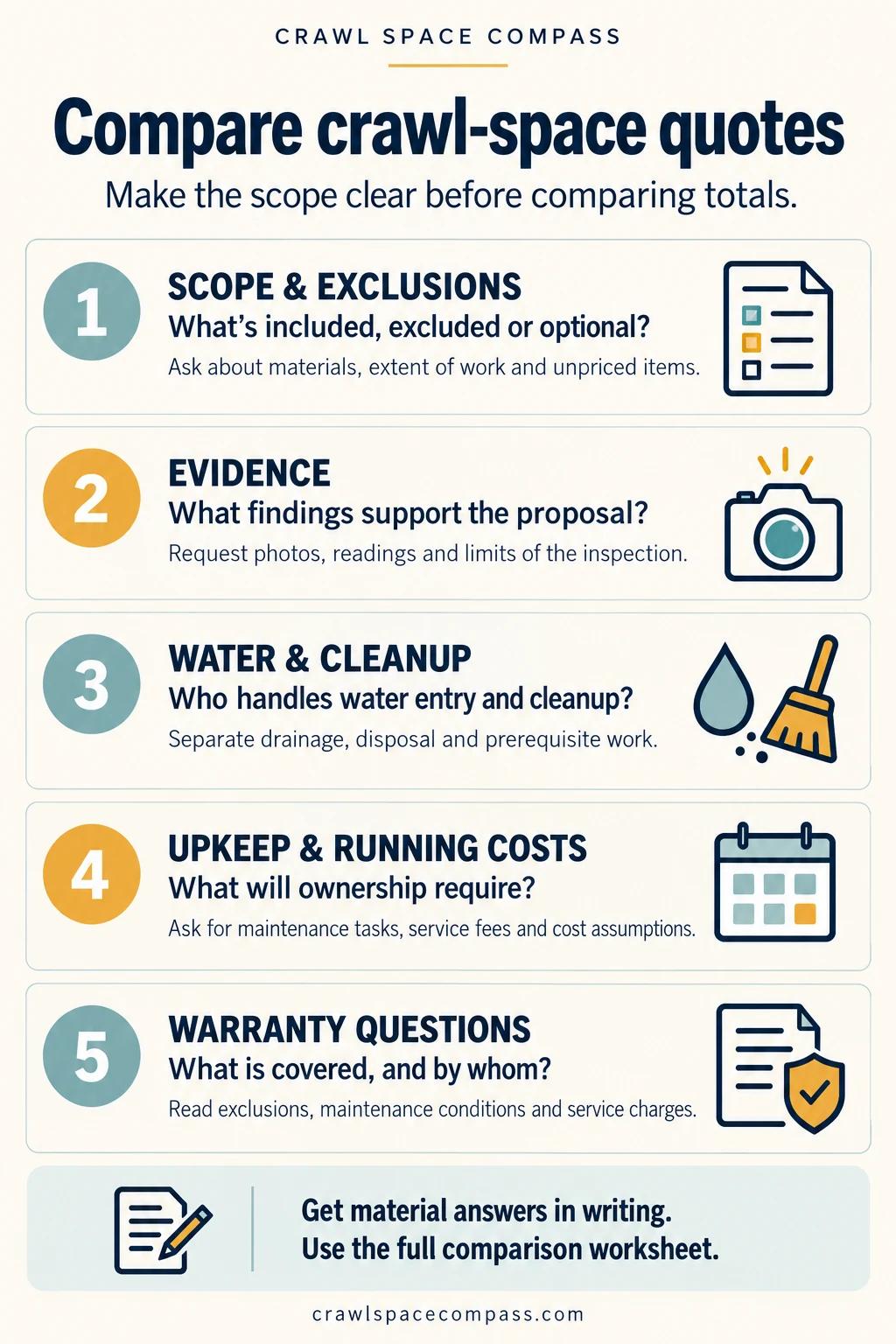
Read the full text version and comparison worksheet for these five questions.