
Crawl Space Encapsulation Cost in North Carolina: Budget and Permit Guide
Updated October 6, 2026.
How much does crawl space encapsulation cost in North Carolina?
North Carolina encapsulation cost depends on your crawl space's condition and the finished system. Build your budget from an inspection and a written scope. A ground vapor barrier, a closed-crawl conversion and a conversion with drainage or framing repairs are different projects. Your total needs to include preparation, water control, liner and sealing, the chosen moisture-control system, applicable trade work, permits and any repairs.
This guide does not give a North Carolina dollar average: the official sources below establish design and permitting considerations, not a dataset of local installed prices. Use the worksheet to turn an inspected scope into a complete budget. A square-foot figure is useful only after you know what it includes. Our general encapsulation cost guide explains published national benchmarks and their limits; they do not establish a local North Carolina quote.
Jump to: NC permits · Budget worksheet · Condition scenarios · Ownership costs · FAQs
Start with North Carolina's closed-crawl permit requirement
The NC Office of State Fire Marshal's December 11, 2025 interpretation says converting a conventional, wall-vented crawl space to a closed crawl space requires a permit regardless of cost. It explains that the moisture-control options trigger regulated mechanical or electrical work. The interpretation specifies a single permit that includes building, mechanical and applicable electrical inspections.
Before accepting a proposal, ask the local inspections office to confirm the process for your address and proposed work. Have the contractor identify the permit applicant, fees, required inspections and responsibility for corrections. Keep this separate from whether a particular contractor needs a general-contractor license. Our crawl-space permit guide helps you prepare an address-specific scope for the local office.
A useful permit question is: “We are converting a vented crawl space, using this moisture-control method and doing these electrical or mechanical changes. What documentation and inspections will you require?” That gives the office something concrete to review. “Do I need a permit for plastic?” may describe a much narrower job than the one being sold.
Ask who is responsible for the chosen drying method. OSFM's moisture-control and H-3 licensing guidance ties the heating-contractor requirements to the method used. Confirm the actual mechanical and electrical work with the local office and relevant licensing board. Have the proposal identify each trade, its price, and whether inspection or startup visits are included.
North Carolina encapsulation cost: five planning decisions
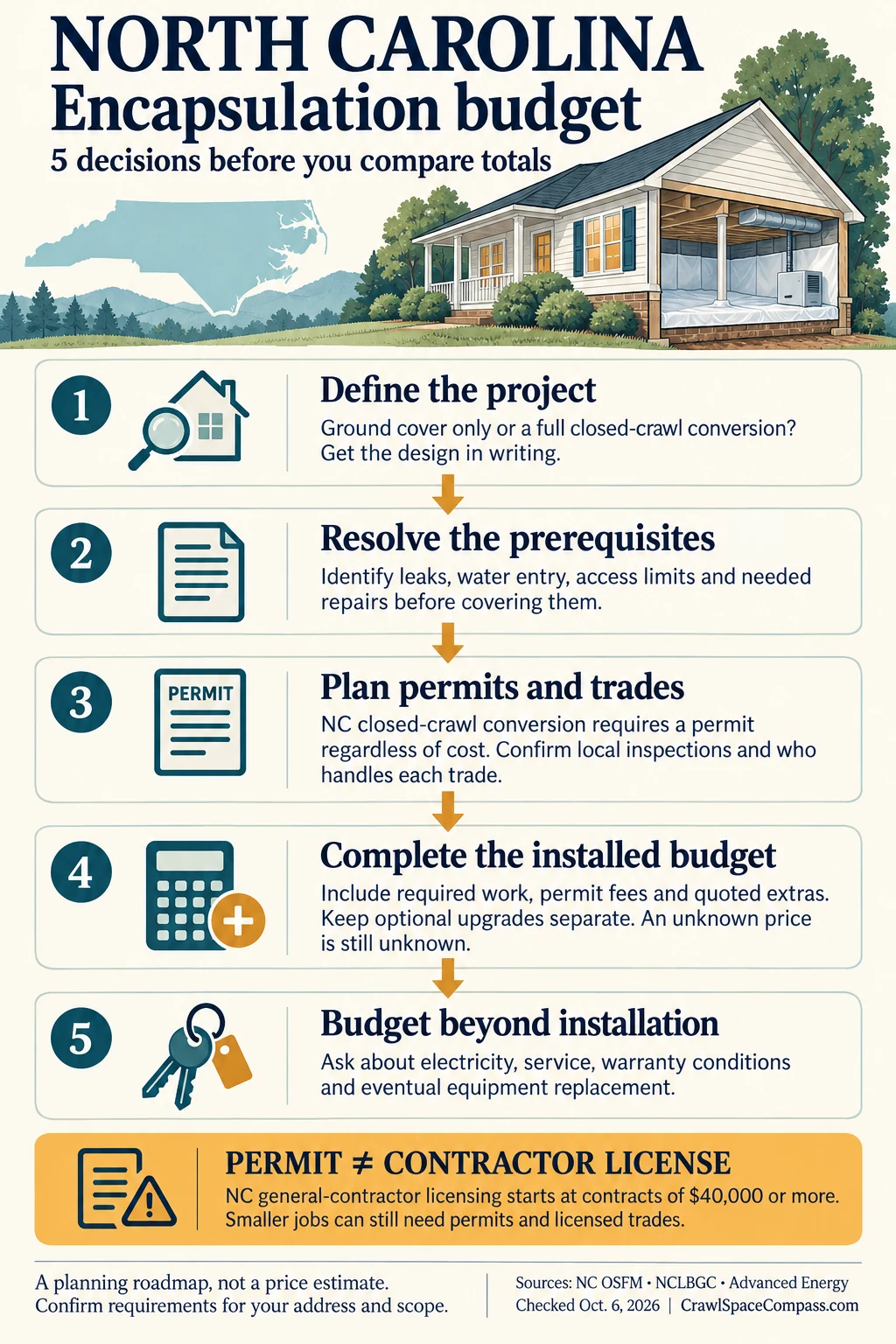
Use this roadmap to organize the questions that affect a complete budget. It is a homeowner planning aid; the contractor and local authority determine the project's design, construction sequence and inspections.
Read the budget roadmap as text
North Carolina encapsulation budget: five decisions before you compare totals
- Define the project: Ground cover only or a full closed-crawl conversion? Get the design in writing.
- Resolve the prerequisites: Identify leaks, water entry, access limits and needed repairs before covering them.
- Plan permits and trades: NC closed-crawl conversion requires a permit regardless of cost. Confirm local inspections and who handles each trade.
- Complete the installed budget: Include required work, permit fees and quoted extras. Keep optional upgrades separate. An unknown price is still unknown.
- Budget beyond installation: Ask about electricity, service, warranty conditions and eventual equipment replacement.
Permit and contractor license are separate checks. NC general-contractor licensing starts at contracts of $40,000 or more. Smaller jobs can still need permits and licensed trades. Confirm requirements for your address and scope.
The house is a conceptual illustration, not an installation detail. The roadmap contains no local price estimate. Sources: NC OSFM, the North Carolina Licensing Board for General Contractors and Advanced Energy, checked October 6, 2026.
Measure the job before using a price per square foot
Ask for the measured crawl-space footprint, rather than automatically using the home's advertised living area. Record low-clearance sections, the entrance size, separate compartments, wall height and the number of piers. Two crawl spaces with the same floor area can require different amounts of material and detailing.
Have the inspection distinguish water entering the space from moisture in the air. Advanced Energy's closed-crawl-space guide explains that a sealed liner is not designed to stop liquid groundwater intrusion and that a closed crawl needs an intentional drying method. Its building-science guidance is useful background; the local authority determines the applicable requirements for your installation.
Request photographs and a written explanation of each proposed repair. Our crawl-space inspection checklist can help organize the findings without asking you to enter a hazardous or inaccessible space.
North Carolina project budget worksheet
Copy this worksheet and fill it with written prices after inspection. Blank amounts are intentional; they are not estimates. Mark a line “included in…” or “not needed,” with an explanation, rather than assuming a missing item is free.
| Budget line | What the price should identify | Your amount |
|---|---|---|
| Investigation and preparation | Access, debris removal, old liner or insulation removal, disposal and any further assessment. | $_____ |
| Water-source corrections | Specific leak, exterior drainage or interior drainage work; discharge location; sump equipment if needed. | $_____ |
| Liner and sealing | Material specification, floor and wall coverage, pier details, seams, penetrations and access-door treatment. | $_____ |
| Insulation | Location, product, coverage, removal of existing material and required protective details. | $_____ |
| Moisture control | Selected system, equipment model where relevant, installation and condensate disposal. | $_____ |
| Electrical or mechanical work | Who performs it and whether power, wiring, controls or HVAC alterations are included. | $_____ |
| Permit and completion | Fees, inspections, startup checks, documentation and return visits included in the price. | $_____ |
| Separate repairs | Itemized framing, pest-related or other work supported by inspection findings. | $_____ |
| Defined allowances | Unresolved work, allowance basis and the process for approving a changed price. | $_____ |
| Installation total | Sum once; confirm applicable tax and disposal charges are included. | $_____ |
Keep optional upgrades outside that total until you choose them. If a proposal bundles several rows, request a written explanation of the bundle. The purpose is to expose missing scope, not to force every contractor into the same billing format.
Three conditions that change the budget
1. Accessible crawl space with no unresolved water intrusion
If inspection finds sound framing and no unresolved leaks or standing-water problem, the budget can focus on the specified liner, sealing, insulation and moisture-control design. Ask what existing material can remain, what will be replaced and what evidence supports that choice. “No water seen today” is a finding to document, not a promise about every future storm.
2. Water appears after rain
Ask for the suspected entry path and the evidence behind the proposed correction. Is water coming from roof runoff, an exterior grading problem, seepage or another source? Price the correction separately from encapsulation. Define who checks the result and when. A package that adds a sump without explaining the water source or discharge route leaves important budget questions open.
3. Restricted access or damaged framing complicates conversion
A cramped entrance, obstructing equipment, deteriorated wood or a suspected pest problem changes the preparation and sequence. Obtain the necessary assessment before covering surfaces. Ask whether repair crews must return after installation and who pays to open and restore the liner. Do not treat framing repairs as an undefined “encapsulation extra.”
These are planning scenarios, not North Carolina price tiers. A house in Raleigh, Charlotte, Greensboro or a coastal county should be priced from its actual findings. Use the North Carolina directory to start a local search, then verify each provider's suitability for the work.
Account for ownership costs after installation
Ask about filter replacement, drain checks, service visits, warranty-related maintenance and eventual equipment replacement. Use our encapsulation lifespan and maintenance guide to separate liner, equipment and workmanship responsibilities. If electricity is part of the system, use actual equipment information and your utility rate rather than a promised universal monthly cost.
Electricity estimate: input watts ÷ 1,000 × operating hours × electricity price per kWh. As a hypothetical arithmetic example, a 500-watt device running six hours daily for 30 days at $0.15/kWh would use 90 kWh and cost $13.50. Those numbers are not an equipment recommendation, a North Carolina rate or a prediction of runtime.
For a chosen ownership period, add installation, electricity, maintenance and expected replacements. Keep those estimates separate from any claimed energy savings unless the seller explains the evidence and assumptions for your home.
Five questions North Carolina homeowners ask
Does a closed-crawl conversion need a permit below $40,000?
Yes. The cited OSFM interpretation requires a permit for conventional-to-closed-crawl conversion regardless of cost. Ask the local inspections office about the application and inspection process for your project.
What will a 1,500-square-foot crawl space cost?
Area alone cannot produce a defensible installed price. Use 1,500 square feet only if it is the measured crawl-space area, then obtain prices for the worksheet's required work. Wall coverage, access, water problems and repairs still matter.
Is a dehumidifier always the required moisture-control method?
No. The OSFM interpretation lists several moisture-control approaches, including a permanent dehumidifier and methods involving conditioned or mechanically moved air. Have the proposed design and its applicable requirements confirmed before treating any one device as mandatory.
When is a North Carolina general-contractor license required?
The NC Licensing Board for General Contractors says a license is required when the contract is valued at $40,000 or more. That threshold does not settle permitting or trade-licensing questions for a smaller job. Identify the actual electrical and mechanical providers too.
Is adding a ground vapor barrier the same project?
No. A ground cover alone is a narrower scope than a designed closed crawl with sealed openings and moisture control. Have the proposal say which result it delivers. See our encapsulation overview for the system components.
Before you approve the budget
Resolve missing permit responsibility, unexplained allowances and excluded trade work before comparing totals. Use our quote-comparison guide for the full side-by-side review. Request completion photographs, equipment instructions, inspection documentation where applicable and a clear contact for follow-up service.
Source note: Official permitting and licensing sources were checked October 6, 2026. Advanced Energy's manual provides building-science background, not a current local code determination. The roadmap and worksheet are original educational decision aids based on those sources, not a site-specific design, permit determination or survey of local prices.