
Crawl Space Encapsulation Cost in Georgia: Scope and Budget Guide
Crawl space encapsulation cost in Georgia depends on the inspected condition, the complete installation scope and the work each provider will handle. Build your budget from itemized local quotes that separate water repairs, enclosure materials, humidity control, permits and any pest or structural work.
Updated October 6, 2026.
What determines crawl space encapsulation cost in Georgia?
The same floor area can produce different proposals when one includes drainage, access work or damaged-material repairs and another does not. Ask each company to identify the findings behind its recommended scope. A low package price tells you little until the inclusions, exclusions and responsibilities are clear.
This guide does not publish an Atlanta or statewide price average. The government and university sources cited here do not provide a verified dataset of local installation prices. Instead, the worksheet helps you build a budget from actual proposals and avoid counting incomplete bids as comparable projects. For broader context, our national encapsulation cost guide explains third-party benchmarks and their limitations; those figures are not verified Georgia prices.
Jump to: Codes and permits · Pest coordination · Budget worksheet · Condition scenarios · FAQs
Georgia quote planning: who confirms what?
Use this responsibility map alongside the cost worksheet. It helps you spot work that is missing from a proposal or counted twice. The roles below are planning prompts, not a requirement to hire six separate companies.
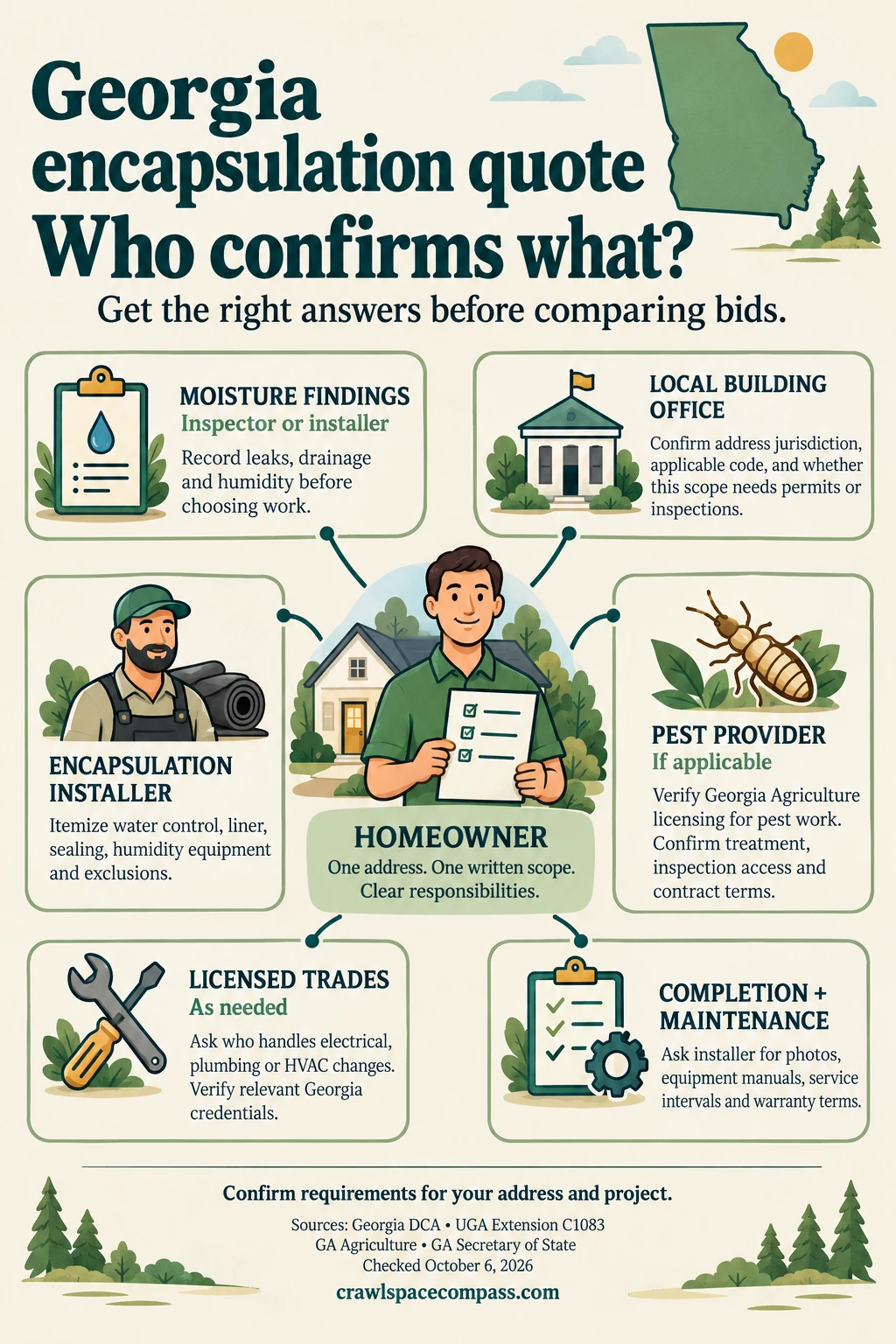
Read the Georgia responsibility map as text
Georgia encapsulation quote: Who confirms what? Get the right answers before comparing bids. Homeowner: one address, one written scope, clear responsibilities.
- Moisture findings, inspector or installer: Record leaks, drainage and humidity before choosing work.
- Local building office: Confirm address jurisdiction, applicable code, and whether this scope needs permits or inspections.
- Encapsulation installer: Itemize water control, liner, sealing, humidity equipment and exclusions.
- Pest provider, if applicable: Verify Georgia Agriculture licensing for pest work. Confirm treatment, inspection access and contract terms.
- Licensed trades, as needed: Ask who handles electrical, plumbing or HVAC changes. Verify relevant Georgia credentials.
- Completion and maintenance: Ask the installer for photos, equipment manuals, service intervals and warranty terms.
Confirm requirements for your address and project. Sources: Georgia DCA, UGA Extension C1083, Georgia Agriculture and Georgia Secretary of State, linked below. Checked October 6, 2026. Original illustration by Crawl Space Compass.
Turn the answers into one coordinated proposal
Give the installer the same inspection findings and proposed scope that you use when speaking with the permit office or pest provider. Record each answer with the provider's name, the date and the affected budget line. If an answer is still pending, mark that line as unresolved rather than assuming it is included.
Before scheduling installation, ask who will coordinate the sequence: necessary water or structural repairs, pest review when applicable, trade work, required inspections and enclosure installation. This order is project-specific. Confirm which work must remain visible for inspection and who will restore any liner or insulation opened by a later crew.
For each allowance, request the condition that would trigger extra work, how the added price would be established and how you would approve it. Then ask for a completion list: photographs, equipment and maintenance documents, applicable inspection records and the contact responsible for a return visit. Those details make the proposal easier to compare and the handoff easier to verify.
Find the moisture source before selecting a package
The University of Georgia's moisture inspection checklist calls attention to leaks, humidity, sump operation, ground covering, gutters, downspouts and water pooling near the foundation. These are useful inspection categories because moisture management can involve work both inside and outside the crawl space.
Ask the person inspecting the home to describe what was observed, what remains uncertain and what each proposed component will address. A liner, a drainage system and a dehumidifier perform different jobs. A proposal should explain their relationship rather than presenting them as interchangeable upgrades.
For budgeting, record the actual crawl-space area, wall coverage, access restrictions and equipment already present. A 1,500-square-foot home does not automatically have a 1,500-square-foot crawl space. Ask for photographs of inspected sections and a list of areas the inspector could not access. Our inspection checklist provides a structure for those findings.
Check Georgia's current codes and the local permit process
As checked October 6, 2026, Georgia DCA's current-code list identifies the 2024 International Residential Code with Georgia amendments. Its linked 2026 residential amendment packet is revised January 1, 2026. Do not rely on an old proposal template to identify today's code edition.
DCA explains that local code administration can include permits, fees and inspections. Confirm which city or county office serves the property's address and describe the actual work. Installing ground covering alone is not the same scope as changing ventilation, adding powered equipment, modifying wiring or repairing framing.
Ask that office and the contractor:
- Which permits and inspections apply to this scope?
- What design details or equipment information must be submitted?
- Who will obtain permits and perform the electrical or mechanical work?
- What needs inspection before liners or insulation cover it?
- Who handles a correction or return inspection, and is it included?
Document the answers in the proposal. A general assurance that the company “handles everything” does not identify a missing fee or subcontracted task.
Keep pest-control responsibilities visible
If you have a termite service agreement, ask the provider to review the proposed wall covering, insulation and access details before installation. Ask whether the work affects inspection access, treatment access, notification requirements or your existing agreement. Get any necessary conditions in writing so different crews do not give you conflicting instructions after the liner is installed. Our termite and encapsulation guide explains the inspection-access questions to raise before covering surfaces.
Georgia's wood-destroying-organism rules address specific pest-control work and its contracts, including price, warranty terms and renewal conditions. They should not be treated as blanket requirements for every ordinary encapsulation installation. If pest treatment is included, identify the treatment provider and check the Georgia Department of Agriculture's structural-pest license search.
For residential or general-contractor credentials, start with the Secretary of State's contractor board and its linked license search. Match the legal business name and credential to the proposed work; ask who is responsible for separately regulated trades. A listing in a directory does not substitute for these checks.
Georgia encapsulation cost worksheet
Use one copy per proposal. The blank amounts below are for your quotes, not suggested prices. Label every line as priced, included elsewhere, excluded or unnecessary. Record the responsible provider where work is split between companies.
| Budget line | Detail to request | Your amount |
|---|---|---|
| Assessment and preparation | Documented findings, debris removal, old material disposal and access work. | $_____ |
| Leak or runoff correction | Named problem, repair location, responsible provider and completion check. | $_____ |
| Interior water management | Drainage layout, sump if justified, discharge route and restoration work. | $_____ |
| Encapsulation installation | Liner specification, floor/wall/pier coverage, seams, penetrations, vents and door details. | $_____ |
| Insulation | Material and placement, removal, protective details and access for future inspection. | $_____ |
| Humidity-control system | Proposed method, equipment, controls, drainage, startup and service access. | $_____ |
| Trades and permits | Electrical/mechanical providers, applicable fees, inspections and correction responsibility. | $_____ |
| Pest or structural work | Separate diagnosis, provider, scope and price; identify any existing service agreement. | $_____ |
| Unresolved allowances | What remains unknown, the pricing basis and your change-approval process. | $_____ |
| Installation total | Add without double-counting; confirm applicable tax and disposal charges. | $_____ |
Put optional accessories and ongoing service charges below the installation total. A written allowance for a genuinely unknown condition is more informative than an unexplained contingency hidden inside a package.
Three example conditions, three different scopes
1. Humidity concern with no unresolved bulk-water problem
The inspection finds no active leak or standing-water issue requiring separate correction. Focus the proposal on the enclosure details, selected humidity-control method and how its performance will be checked. Confirm the equipment's power and condensate provisions, rather than assuming an advertised device price is the complete installed price.
2. Rain-related water entry needs investigation
The owner reports water after storms. Have the proposal identify the evidence for the entry path and the proposed correction before pricing encapsulation as the entire solution. Ask whether the work is exterior, interior or both, and which contractor is accountable for each part. Include restoration of disturbed areas and a clear discharge plan in the relevant price. Use the water-after-rain guide to organize safe observations before the visit; do not enter a wet or unsafe crawl space to gather evidence.
3. Existing termite coverage or repairs require coordination
The home has an active service agreement, obstructed inspection areas or damaged materials that require assessment. Arrange the necessary pest or structural review before surfaces are covered. Price repairs separately, decide the installation sequence and identify who restores the liner if another trade needs access. This scenario can require more coordination even when the crawl space is small.
These examples are not claims about typical conditions in Atlanta, Athens, Macon or Gainesville. The property's findings, rather than a city label, should determine which scenario resembles your project.
Include operation and maintenance in the decision
Ask for the installed equipment's maintenance instructions, filter costs, drain-service needs and warranty conditions. Clarify which visits are included, optional or required to retain a particular warranty. Also ask how replacement equipment can be brought through the access opening.
For any comparison period, ownership cost equals installation plus electricity, maintenance and replacements during that period. Estimate electricity with equipment input watts divided by 1,000, multiplied by actual or clearly assumed operating hours and your electricity rate. Do not subtract advertised energy savings unless their assumptions are relevant and documented.
Georgia cost FAQs
What does encapsulation cost in Atlanta?
An address and square footage alone are not enough for a reliable quote. Obtain an inspected, itemized scope and use the worksheet to include water corrections, equipment, trades and repairs. This guide does not claim a verified Atlanta average.
Does Georgia require an encapsulation permit?
Confirm with the city or county office serving your property. The answer depends on the actual work, including equipment, wiring, ventilation and structural changes. Ask before work starts, and put permit responsibility and fees in the proposal.
Does the price normally include drainage?
Do not assume it does. Ask whether drainage is included, excluded or unnecessary based on the inspection. Where proposed, require its layout, discharge destination and installed price rather than a generic “water management” label.
Will encapsulation replace termite treatment?
Do not treat it as a substitute. Clarify pest-control needs with an appropriately licensed provider and coordinate with any existing agreement. Encapsulation pricing and pest-treatment pricing should identify their separate purposes and responsibilities.
How should I choose between two different scopes?
Have each provider explain the evidence for work the other omitted. Resolve the design difference before choosing by total price. Our quote-comparison guide covers the detailed side-by-side review.
Your next step
Bring your inspection findings and completed worksheet to the conversation with a provider. Use the Georgia directory to begin a local search, then verify qualifications and scope directly. Request photographs, equipment documents, applicable inspection records and clear service contacts when the job is finished.
Source note: State code, licensing and university resources were checked October 6, 2026. This guide is educational budgeting guidance; your local authority and project professionals must confirm the requirements and design for your property.