
Crawl Space Mold: What Homeowners Should Do First
Last reviewed: October 3, 2026
Start by making sure the crawl space is safe to approach, identifying the moisture source, and arranging appropriate cleanup. A mold spray, new liner, or dehumidifier by itself does not complete that job. Visible growth and musty odors deserve investigation, but a photograph cannot establish the species, the extent of hidden damage, or anyone’s health risk.
The useful question is: what is keeping this material damp, and what work will correct that condition? EPA’s homeowner mold guide makes moisture correction central to preventing the problem from returning.
In this guide: First, decide whether entry is safe · Find the moisture pathway before choosing the repair · When is professional remediation the right next step? · Review cleanup before covering · Frequently asked questions
Crawl space mold: plan the work at a glance
Use these five prompts when discussing findings and next steps with the professionals assessing your crawl space. Review their records from a safe location. The work sequence and methods should reflect the conditions at your property.
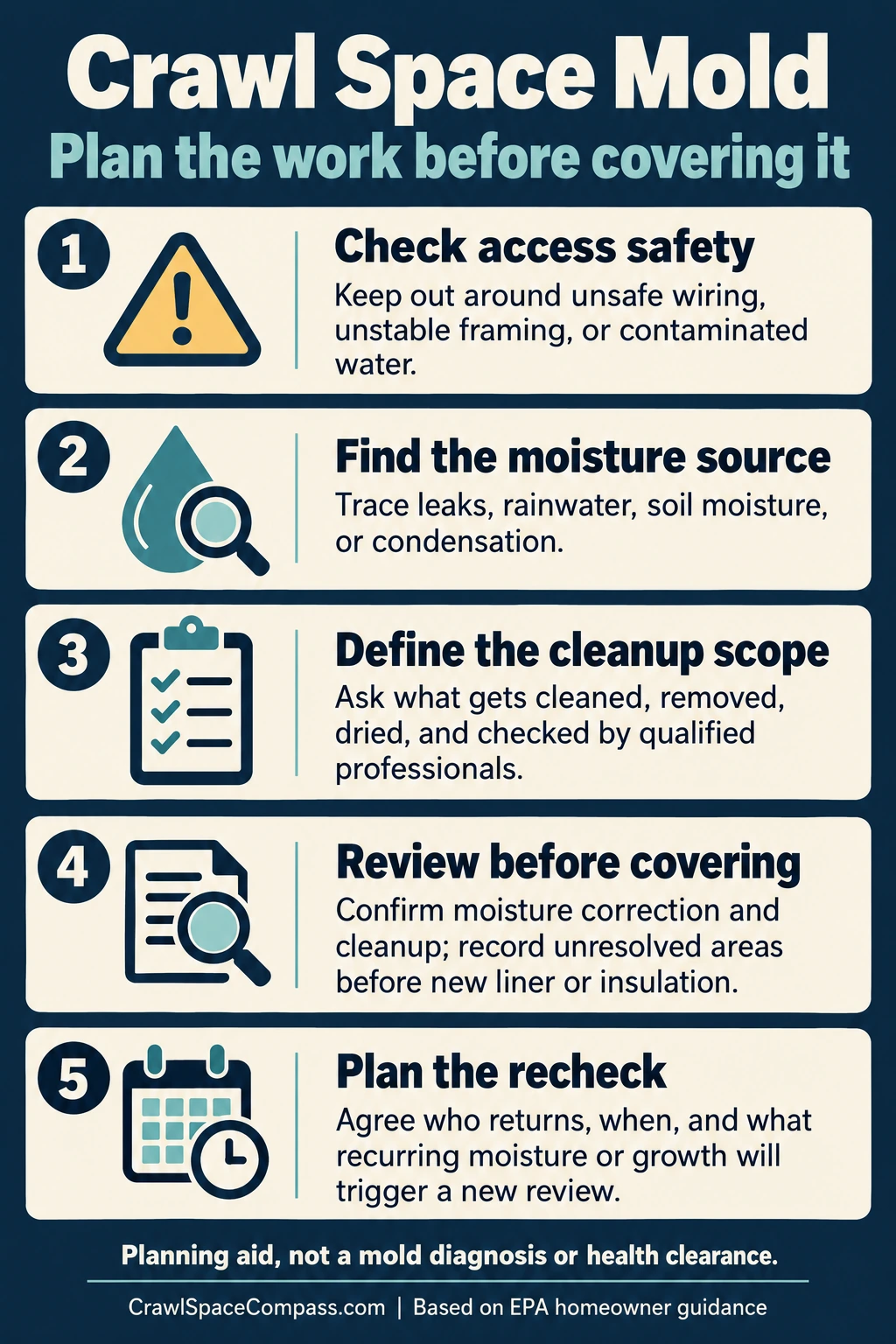
Read the complete graphic text
Crawl Space Mold
Plan the work before covering it
- Check access safety. Keep out around unsafe wiring, unstable framing, or contaminated water.
- Find the moisture source. Trace leaks, rainwater, soil moisture, or condensation.
- Define the cleanup scope. Ask what gets cleaned, removed, dried, and checked by qualified professionals.
- Review before covering. Confirm moisture correction and cleanup; record unresolved areas before new liner or insulation.
- Plan the recheck. Agree who returns, when, and what recurring moisture or growth will trigger a new review.
Planning aid, not a mold diagnosis or health clearance.
CrawlSpaceCompass.com | Based on EPA homeowner guidance.
The moisture, cleanup, and recheck principles follow EPA's homeowner mold guidance. The documentation prompts are practical planning suggestions. For a location-specific record, see review cleanup before the work is covered.
First, decide whether entry is safe
You do not need to crawl underneath the house to start documenting a problem. Stay outside if you see standing water near wiring, damaged electrical equipment, unstable supports, sagging framing, sewage, significant animal waste, or an access route you cannot use safely. Leave suspected hazardous materials undisturbed. Arrange the appropriate inspection before entering.
PNNL’s crawl-space assessment guidance calls for resolving electrical hazards and addressing structural, water, and hazardous-material problems before retrofit work. A mold-cleanup appointment is not a substitute for an electrician or structural professional when those hazards are present.
CDC advises people with allergies, immune suppression, underlying lung disease, asthma, or COPD against participating in mold cleanup. Ask a qualified health professional about personal exposure concerns. Protective equipment does not make an otherwise unsafe crawl space safe.
Match the first action to what you observe
| What you notice | Useful next step | What to avoid |
|---|---|---|
| Water after storms | Document where it appears; arrange a drainage and water-entry assessment. | Covering the evidence with a new liner before tracing the source. |
| A plumbing drip or wet area below a fixture | Have the leak repaired and affected materials assessed for drying or removal. | Assuming a dehumidifier will compensate for an active leak. |
| Growth, staining, or odor without obvious water | Check moisture history, ground cover, humidity, and condensation with a qualified inspector. | Using color or odor to identify a mold species. |
| Widespread growth, hidden damage, or affected ducts | Arrange an experienced remediation assessment and involve HVAC expertise where needed. | Disturbing insulation or running fans through affected areas as an improvised cleanup. |
| Sewage, unsafe wiring, or possible structural failure | Keep out and contact the relevant qualified professionals. | Entering to measure the patch or retrieve a sensor. |
This table is a planning aid. The same crawl space can have several moisture sources and require more than one trade.
Find the moisture pathway before choosing the repair
Start with observations that can be made safely outside: overflowing gutters, downspouts discharging beside the foundation, low spots collecting runoff, and wet areas around the access opening. Note whether the problem follows rain or occurs during dry weather. The University of Georgia’s home moisture checklist connects exterior water management with inspection of crawl-space leaks, ground cover, joists, and moisture conditions.
Inside, a qualified inspector may find several different pathways:
- Liquid water entering through the foundation or access opening.
- A plumbing leak or incorrectly draining equipment condensate.
- Moisture evaporating from exposed soil.
- Humid air reaching cold surfaces and producing condensation.
- A drying or humidity-control system that is missing, disconnected, or not working as intended.
EPA’s mold course explains soil evaporation, groundwater entry, and high humidity as crawl-space moisture concerns. For a rain-related pattern, use our water after rain guide to organize the investigation.
Act promptly on newly wet materials
EPA recommends drying wet or damp areas and materials within roughly 24–48 hours to help prevent growth. Treat that as a reason to arrange safe water removal and drying promptly, not a countdown that guarantees a particular outcome. Existing growth may predate the latest leak, and a dry-looking surface does not establish that a material has dried throughout.
After sewage or potentially contaminated flooding, get experienced professional help. Do not apply ordinary clean-water drying advice without addressing contamination and entry hazards first. Ask who will assess materials, document drying, and decide what can remain.
When is professional remediation the right next step?
EPA’s cleanup guidance says a small moldy area, less than about 10 square feet, can often be handled by a homeowner in ordinary circumstances. It also identifies substantial water damage, larger affected areas, contaminated water, HVAC involvement, and health concerns as reasons for additional guidance or professional assistance.
That area figure is a screening consideration, not a safety threshold. Restricted access, overhead work, uncertain materials, and inability to isolate the work can make a small crawl-space job unsuitable for DIY cleanup. Seek experienced help when you cannot confidently establish the scope or work safely.
If the HVAC system itself is known or suspected to be contaminated, EPA advises against operating it until the issue is addressed because it may spread mold. Have an HVAC professional and remediator coordinate the assessment; growth somewhere in the crawl space does not automatically prove contamination inside the system.
Cleanup, moisture repair, and encapsulation have different jobs
A complete proposal should explain these separately:
- Moisture correction: identify and repair the water or vapor source.
- Cleanup and material decisions: specify affected areas, what will be cleaned, and what requires removal or further assessment.
- Long-term control: describe ground-vapor control, air sealing, drainage, insulation, and drying equipment where the design calls for them.
- Verification: document the completed work and explain how conditions will be checked afterward.
Encapsulation can be part of long-term moisture management. It does not remove existing growth or establish that damaged framing is sound. Ask contractors to explain how cleanup and drying fit into the installation sequence rather than allowing the new liner or coating to hide unresolved conditions.
Use our crawl-space humidity guide to distinguish air readings from evidence about wet materials. A crawl-space dehumidifier addresses moisture in the air. It cannot perform mold removal, repair a plumbing leak, or prevent all rainwater entry. Changing vent operation also needs a whole-system plan; see open versus closed crawl-space vents.
What to collect before requesting estimates
Use this checklist from a safe location, or ask the inspector to provide the information. Our crawl-space inspection checklist can keep the record consistent.
- The date the issue was noticed and its relationship to rain, plumbing use, or cooling season.
- Wide-view and closer photographs with locations identified, without disturbing materials.
- The estimated affected area and the materials involved, with inaccessible areas noted.
- Temperature and humidity readings labeled by time and sensor location, if safely available.
- Past leaks, repairs, drainage work, or previous cleanup.
- A list of hazards or areas that require a specialist before further inspection.
When you compare crawl-space quotes, ask each provider to identify the suspected source, evidence supporting it, cleanup method, material-removal scope, drying checks, and return-visit plan. Ask who handles containment and protects adjoining living areas. A vague “mold treatment” line item does not explain those decisions.
Review cleanup before the work is covered
Completion-review guidance checked October 8, 2026.
Ask for a completion review before new insulation, a liner, or a coating obscures affected areas. Review the professional’s record from a safe location; this is not a reason to enter the crawl space yourself.
Separate remaining stains from unresolved work
EPA’s homeowner mold guide notes that staining or cosmetic damage can remain. Discoloration alone cannot establish whether cleanup succeeded or failed. Ask the professional to explain remaining marks and the evidence supporting their assessment. EPA’s completion guidance calls for the moisture problem to be corrected, mold removal completed, and visible mold and moldy odors absent, followed by a revisit.
Request a location-specific completion record
Before affected areas are covered, ask the contractor to show:
- Source correction: where moisture entered or accumulated, what correction was completed, and how it was checked.
- Material decisions: which affected materials were removed and which surfaces were cleaned, with dated before-and-after photographs of the same locations.
- Readiness for the next step: drying observations or measurements, their locations and dates, and the professional’s explanation of whether installation can proceed.
- Open items: excluded, inaccessible, or unresolved areas, who will assess them, and what happens before they are concealed.
These are practical documentation requests, not a universal clearance standard. A single photograph or humidity reading does not settle every question.
Know what a sample would answer
If testing is proposed, ask what uncertainty it will resolve and how the result will change the next step. EPA says surface sampling can sometimes help assess cleaning, but sampling design and interpretation require relevant expertise. There is no federal airborne mold threshold establishing a universal pass. See our indoor-air-quality guide for the limits of broader air-quality claims.
Hypothetical example: The record shows cleaned joists and a new ground liner, but a plumbing repair remains pending and wet insulation is outside the documented cleanup area. Completion remains unresolved. Ask for assessment before those areas are covered, rather than treating the finished liner as proof.
Agree on a recheck shortly after cleanup. Returning wetness, growth, or moldy odor warrants reassessment, including professional investigation of hidden areas when appropriate.
Frequently asked questions
Can I identify crawl-space mold by its color?
Do not use a color description or online photograph as a diagnosis. Record the location and appearance, but focus on moisture, affected materials, and necessary work. CDC notes that mold can have many colors and that knowing its type is not necessary before addressing it.
Do I need a mold test before making repairs?
EPA says sampling is usually unnecessary when visible mold growth is present. Specialized testing may answer a defined question, but there are no federal airborne mold limits against which a home can simply “pass.” Ask what decision a proposed test would change and who will interpret it.
Should I spray bleach on the joists?
Do not treat bleach as a universal solution. EPA does not recommend biocides as a routine mold-cleanup practice. Material condition and cleanup method matter, and killing growth alone does not remove it. Never mix bleach with ammonia or other cleaning products. Restricted crawl-space access is another reason to seek professional advice before using chemicals.
How can I tell whether the work is complete?
Request photographs, a record of corrected moisture sources, material and drying documentation, and clear instructions for monitoring. Arrange follow-up when the conditions that caused the problem return, such as another rain event. Persistent odor, new wetting, or recurring growth calls for reassessment rather than another cosmetic treatment.
Will cleanup or encapsulation resolve health symptoms?
No building repair can promise a medical outcome. A qualified clinician should evaluate symptoms and exposure concerns. A contractor’s role is to assess and correct building conditions within their expertise.
Choose help based on the problem
Use our contractor directory to locate providers and compare their documented scope. Confirm relevant remediation experience and references; directory inclusion is not a substitute for checking qualifications. Electrical, structural, plumbing, HVAC, or health concerns may require separate professionals.