Public design preview · Existing article text retained. Layout adapted to the new directory. View current public article ↗
Crawl Space Encapsulation Cost in 2026
Crawl space encapsulation cost depends on the measured area, water problems, repairs, and the complete installation scope. For an initial national budget, published 2026 guides put professional encapsulation in the thousands to low tens of thousands of dollars. HomeGuide reports $3,000–$15,000 overall and $3–$10 per square foot; Angi reports $5,000–$15,000. These are third-party estimates, not Crawl Space Compass transaction data or a price promise. Your usable budget comes from a measured crawl space, a diagnosis, and an itemized installed quote.
Pricing sources reviewed: October 3, 2026. Scope checklist and graphic added: October 6, 2026.In this guide:What national cost benchmarks actually tell you · Compare scenarios by scope, not invented price tiers · Frequently asked questions
What national cost benchmarks actually tell you
Published U.S. consumer cost guides, checked October 3, 2026
A separate publisher's estimate. An average does not establish what your project should cost.
These sources use different descriptions of scope and pricing. Neither page gives enough project-level detail to make an apples-to-apples national invoice comparison. We have not combined their figures into a new average, applied an inflation adjustment, or treated their ranges as ceilings.
The Crawl Space Report's methodology, another public benchmark reviewed for this guide, explicitly uses a calculator model with size and condition multipliers. A modeled result should not be mistaken for an observed local sale. A quote outside any online range deserves a scope explanation, rather than an automatic verdict that it is unfair.
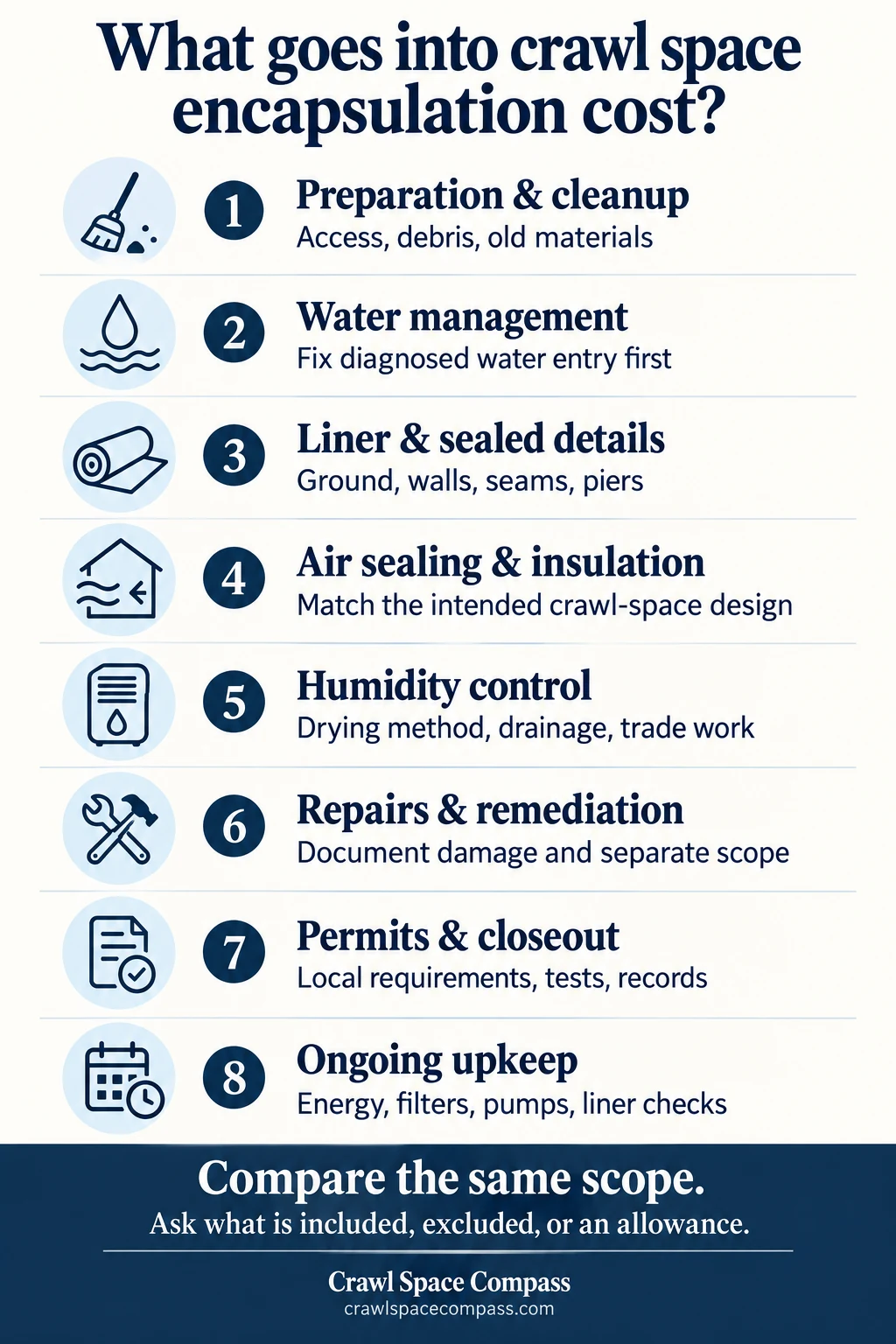
What goes into crawl space encapsulation cost?
Use this visual checklist to spot missing scope before comparing totals. Some homes need only certain repairs or water-control measures; ask the contractor to connect each proposed item to the inspection findings.
Compare the same scope. Ask what is included, excluded, optional, or an allowance. Open the full-size scope checklist.Text version of the scope checklist
Preparation and cleanup: access, debris, and old materials.
Water management: fix diagnosed water entry first.
Liner and sealed details: ground, walls, seams, and piers.
Air sealing and insulation: match the intended crawl-space design.
Humidity control: drying method, drainage, and trade work.
Repairs and remediation: document damage and define a separate scope.
Permits and closeout: local requirements, tests, and records.
Ongoing upkeep: energy, filters, pumps, and liner checks.
Compare the same scope and ask what is included, excluded, optional, or an allowance. The detailed worksheet below separates installed work from ongoing upkeep.
Measure the crawl space before multiplying a price
Use the crawl-space footprint, not the home's total living area. An upstairs floor adds living area without adding ground beneath it; a slab addition or garage may not belong in the measured crawl. Ask bidders to show their dimensions on the same sketch.
Ground area: divide an irregular footprint into rectangles and add their length × width measurements.
Wall coverage: record perimeter and proposed liner height separately. Note openings and required inspection clearances.
Detail work: count piers, vents, access doors, plumbing penetrations, and other obstacles.
Access: record entry dimensions, restricted-height sections, debris, and disconnected compartments.
For a simple geometry example, a 30-by-40-foot crawl has 1,200 square feet of ground and a 140-foot perimeter. Covering three feet of wall height adds 420 square feet before adjustments. Seams, overlaps, piers, and waste add material beyond that calculation. This illustrates quantities, not an installation specification or cost estimate.
Request measurements and photographs from the inspector if access is unsafe. DOE's pre-retrofit assessment guidance calls for resolving electrical hazards before inspection and checking combustion-air and venting arrangements before air sealing around fuel-fired appliances.
Build a crawl space encapsulation cost worksheet
Use this worksheet when requesting bids. For every row, record each contractor's installed price and mark it included, excluded, optional, or an allowance. An allowance is a budgeted amount that may change; ask what measurement or discovery would change it.
Scope and quantity worksheet for comparable contractor bids
Fees, responsible party, completion records, taxes, and final installed total
Add mutually exclusive options only if you choose them. Do not add a separate equipment allowance when the equipment is already included in a package. Keep a personally affordable reserve for unresolved conditions, but ask the contractor to identify those conditions instead of using an unexplained contingency percentage.
For the insulation line, compare floor-joist versus foundation-wall insulation against the intended crawl-space design before accepting a material allowance.
Compare scenarios by scope, not invented price tiers
Dry crawl space with an incomplete ground barrier
Ask whether repairing vapor control addresses the documented problem or whether a complete closed-crawl conversion is justified. Compare the proposed outcomes, not just the word “encapsulation.” A limited liner repair and a complete conversion are different bids.
Humid crawl space without standing water
Request a plan for air leakage, ground vapor, insulation, and ongoing humidity control. Ask what measurements support the design and how performance will be checked after installation. The crawl space dehumidifier guide helps frame equipment questions.
Water enters after rain
Have the water pathway diagnosed before pricing the final enclosure. DOE's crawl-space water-management guidance puts drainage and moisture problems ahead of sealing and insulation. Exterior runoff corrections, an interior drain, or pumping may be separate scope items; each needs a reason and a discharge plan. Compare what each component does in our crawl-space drainage options guide. Start with water in a crawl space after rain.
Mold, wet insulation, or damaged framing is present
Request assessment and separate cleanup or repair scopes before accepting a finish-only proposal. EPA guidance emphasizes correcting the moisture problem alongside mold cleanup. Sealing over the evidence is not a substitute for documenting and addressing the cause.
Normalize quotes before choosing a contractor
To compare crawl space encapsulation cost across bids, match the measured footprint and scope before comparing totals.
Use one footprint. Resolve measurement differences before calculating installed cost per square foot.
Match the design. Compare liner coverage, insulation, water control, equipment, and required trade work.
Separate fixed work from uncertainty. Ask for written change-order terms and pricing assumptions for concealed damage.
Compare closeout and warranties. Read coverage for materials, labor, seams, equipment, exclusions, transfer, and required servicing separately.
Compare complete totals. Record taxes, disposal, permits, selected options, and any required first-year service. Keep financing charges separate from the installed cash price.
Update an included allowance without counting it twice
An allowance already included in a package total is part of that total. When the item receives an agreed final price, ask the contractor for a dated revision showing how the original allowance was replaced.
Identify the original amount. Record the package total, the included allowance and the labor, materials or quantities it covered. Confirm that you are comparing the same scope.
Check the replacement. Ask for the agreed final amount and any other changes to scope, taxes or charges. If nothing else changes, the reconciliation is the original total minus the included allowance plus its agreed replacement. Adding the entire replacement to the original total would count the allowance twice.
Use the written revision. Match the revised total to that explanation. Ask about any unexplained difference rather than making your own deduction from a payment.
A required trade marked “by owner” without a price remains unpriced; leave it identified as unknown instead of entering zero. Use the quote-comparison worksheet to keep those gaps visible. The worked example of incomplete quotes explains how missing scope affects comparison.
The FTC recommends written estimates defining the work, materials and price. This reconciliation is an editorial checking method, not a rule about contract rights.
Allowance example and FTC source checked October 11, 2026. Earlier pricing benchmarks have not been refreshed.
Budget for operating costs and maintenance
Ask for the equipment manual, filter requirements, condensate checks, pump testing instructions, and any paid service agreement. Clarify who repairs punctured liner or detached seams after other trades enter. Obtain current service and replacement quotes rather than assuming every component has the same lifespan or warranty. Our encapsulation lifespan and maintenance guide explains what to inspect and how to compare component coverage.
Electricity depends on actual power draw, runtime, and your rate. The U.S. Energy Information Administration explains kilowatt-hours; a planning calculation is watts ÷ 1,000 × operating hours × price per kWh.
Hypothetical arithmetic only: a device drawing 600 watts for six hours daily over 30 days uses 108 kWh. At an assumed $0.18/kWh, that is $19.44 for the month. These are invented inputs, not a typical dehumidifier bill. Use measured consumption where available; include pumps or other equipment separately.
Permits, local requirements, and regional prices
Ask the local building department which permits and inspections your exact scope requires. Use the crawl space permit checklist to prepare a scope description and identify the responsible office. DOE's unvented crawlspace guide flags local insulation, fire, combustion, radon, pest-inspection, and flood requirements. Ordinary vent closure instructions should not be applied to required flood openings without an approved design.
Use the South Carolina, North Carolina, and Georgia cost guides for state-specific questions. This national guide applies no automatic regional discount or markup. Local comparable bids are the relevant price evidence.
Frequently asked questions
How much does a 1,500-square-foot crawl space cost?
HomeGuide's January 2026 size table lists $4,500–$15,000 for 1,500 square feet. Treat that as its published estimate, not a local quote. Drainage, repairs, access, and the final design still need inspection and itemization.
Is a dehumidifier included in encapsulation?
Only if the written scope includes it. Ask which drying method the design uses and whether equipment, installation, electrical work, condensate disposal, and startup testing are included.
What costs more: drainage or encapsulation?
There is no reliable answer without defining both scopes. Ask for separate installed totals and an explanation of how the proposed water-control work fits the diagnosis.
Can DIY work reduce the price?
Ask which preparation tasks the contractor will credit and whether your work affects its warranty. Do not enter a hazardous crawl space or improvise structural, electrical, combustion-air, or flood-control changes to reduce the bill.
Is encapsulation worth the cost?
Judge it against the diagnosed problem, suitable alternatives, and total ownership cost. This guide promises no resale premium, percentage energy saving, or payback period. Request evidence for any savings claim made in a proposal.
Sources and pricing methodology
Except where separately dated, sources linked above were reviewed October 3, 2026. National dollar benchmarks are attributed publisher estimates; technical guidance comes from EPA, DOE's Building America Solution Center, and EIA. Measurement examples, worksheet structure, and hypothetical electricity arithmetic are explanatory tools. Crawl Space Compass has not independently audited the price publishers' underlying records or created a local-price model.
Ready for project-specific numbers? Find crawl-space contractors and request bids using the same measurements and scope.
Turn a price range into a comparable scope
A budget guide cannot price your particular home. Ask companies to itemize the same scope so you can see why their totals differ.
Request these details with each written quote
Price component
Ask the company to specify
Preparation
Access, removal, disposal, cleanup and any repairs assumed before installation.
Materials and labor
Measured quantities, product specifications, covered surfaces and installation details.
Water and equipment
Which drainage, discharge, equipment and electrical items are included or separately priced.
After installation
Maintenance obligations, warranty exclusions, follow-up and costs that may recur.
Changes and payment
What could change the total, who approves extra work, the payment schedule and any financing cost.