Public design preview · Existing article text retained. Layout adapted to the new directory. View current public article ↗
UNDERSTAND THE SCOPE
Crawl Space Encapsulation vs. Vapor Barrier
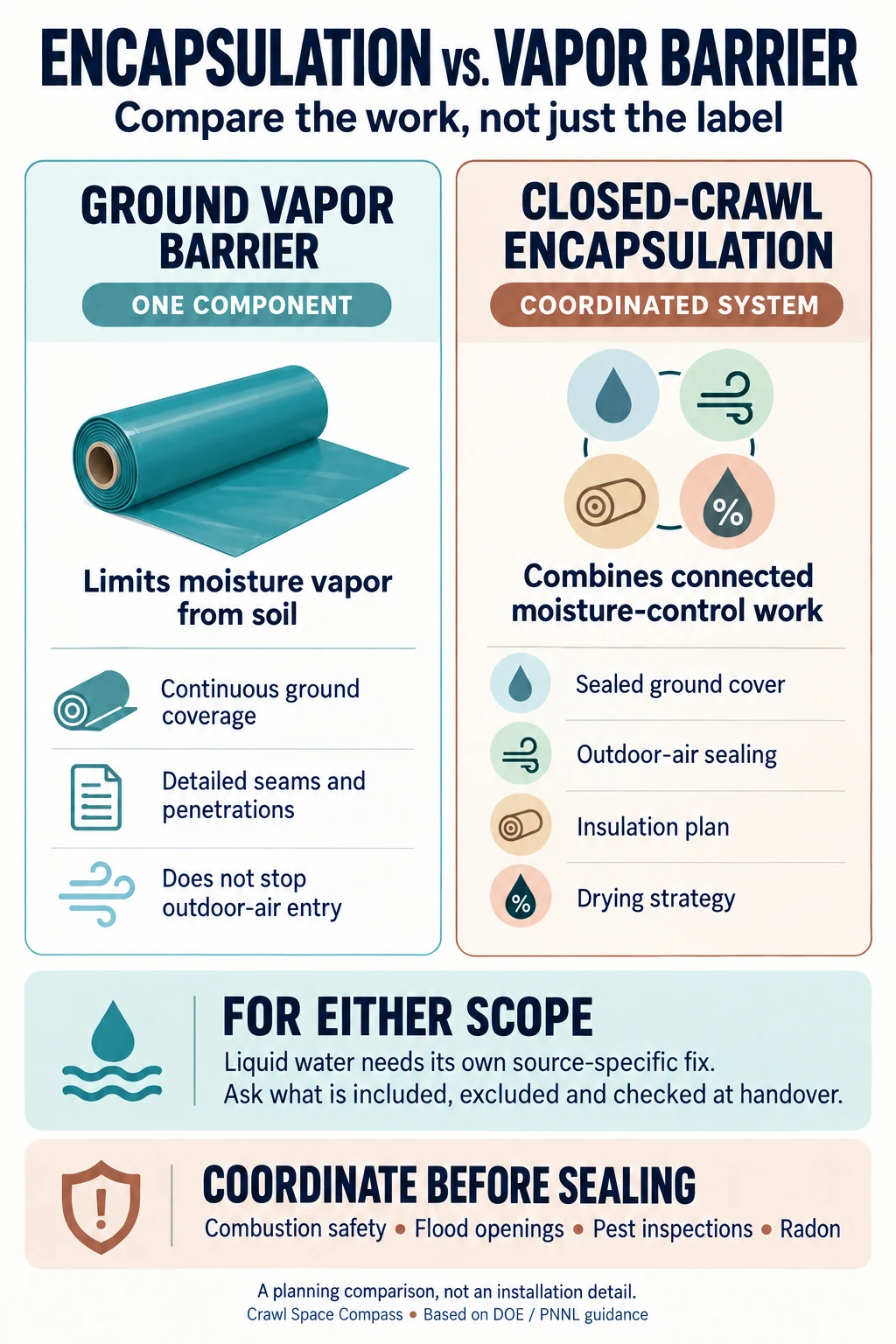
A ground vapor barrier controls one moisture pathway: water vapor rising from soil. Encapsulation usually describes a broader crawl-space system that also addresses outdoor air, enclosure details and humidity control. Neither label tells you whether drainage, repairs or equipment are included. Choose the scope that fits the conditions, then compare written proposals.
Last reviewed: October 3, 2026
A sealed ground liner is a component; a closed crawl space is a system
A ground vapor barrier, also called a vapor retarder or ground liner, covers exposed earth to limit soil moisture entering the crawl-space air. Coverage and continuity matter: a material specification alone says little about exposed edges, gaps around piers or damaged seams. DOE explains how both liquid water and water vapor can enter from the soil in its crawl-space capillary-break guidance.
A sealed ground liner has detailed seams, penetrations and perimeter connections. It can be a major improvement over loose plastic, but it does not automatically make the crawl space closed or conditioned.
Encapsulation is a proposal label worth unpacking. A complete closed-crawl design coordinates ground coverage, outside-air sealing, the insulation approach and a planned drying method. Ask the contractor to identify the final design rather than treating “encapsulation” as a standardized bundle. The DOE vented-to-unvented checklist illustrates how many details a conversion involves.
Encapsulation vs. vapor barrier at a glance
A ground liner can be part of either a vented or closed crawl space. Here, encapsulation means the coordinated closed-crawl approach. Open the full-size comparison graphic.Full text version of the comparison graphicEncapsulation vs. vapor barrier
Compare the work, not just the label.
Ground vapor barrier: one component
Limits moisture vapor from soil.
Continuous ground coverage
Detailed seams and penetrations
Does not stop outdoor-air entry
Closed-crawl encapsulation: coordinated system
Combines connected moisture-control work.
Sealed ground cover
Outdoor-air sealing
Insulation plan
Drying strategy
For either scope
Liquid water needs its own source-specific fix. Ask what is included, excluded and checked at handover.
Coordinate before sealing
Combustion safety • Flood openings • Pest inspections • Radon
A planning comparison, not an installation detail.
Crawl Space Compass • Based on DOE / PNNL guidance
A liner or package name does not establish that drainage, structural repairs, mold cleanup or radon mitigation are included. Confirm the safety and local coordination before sealing.
Technical background: DOE's conversion checklist and PNNL's closed-crawl guidance. Visual sources checked October 9, 2026.
Separate liquid water, ground vapor and humid outdoor air
Liquid water: Rain runoff, groundwater, plumbing leaks and faulty condensate drainage need source-specific repairs or water management. A liner cannot repair a pipe or divert runoff.
Ground vapor: Soil can release moisture without a visible puddle. A continuous ground cover targets that pathway.
Humid outdoor air: During humid weather, incoming air can add moisture and condense on cooler crawl-space surfaces. Covering the soil does not stop air entering through open vents.
PNNL describes the humid-air problem in its unvented crawl-space guide. Its pre-retrofit assessment also flags interior sources such as leaking plumbing and misplaced condensate discharge. More than one pathway can be present. Use the inspection checklist to organize photographs, weather history and measurements before requesting a solution.
Which scope deserves a closer look?
This table is a discussion guide, not a diagnosis from symptoms alone.
Match the proposed work to the observed condition
What you observe
What to investigate
Scope to discuss
Exposed soil, with no known water entry or persistent condensation
Seasonal humidity, ground coverage and evidence of previous wetting
A properly specified ground liner may be a proportionate first improvement; confirm performance afterward.
Recurring summer humidity or condensation despite a ground cover
Outdoor-air entry, duct condition, leaks and existing drying strategy
A coordinated closed-crawl design may address more of the problem than replacing the liner alone.
Puddles or water after rain
Runoff, grading, groundwater and entry points
Diagnose water management first; decide on the enclosure after the source is understood.
Visible growth, damaged insulation or deteriorated framing
Moisture source, cleanup needs and structural condition
Define remediation or repair separately before covering affected areas.
An existing closed crawl space stays damp
Liner damage, air leaks, equipment operation and drainage
Evaluate the existing system before buying a replacement package.
One dry-weather visit cannot establish year-round conditions. Keep dated humidity readings and note whether problems follow rain or humid weather. See crawl-space humidity and drainage options for the next questions to ask.
What should each proposal actually include?
Ground-liner work: Identify the product, thickness, reinforcement, ground preparation, coverage, seam treatment, penetrations, perimeter attachment and protection along service routes.
Closed-crawl conversion: Add a plan for ordinary foundation vents, access doors and other air leaks; define the insulation boundary and the drying approach. Review the separate insulation guide.
Humidity equipment: Specify whether a dehumidifier or another approved drying method is included, along with installation, power, condensate disposal, controls and maintenance. Use the dehumidifier guide to compare equipment scope.
Water management and repairs: State separately whether drainage, a sump, plumbing repairs, cleanup, damaged insulation removal or framing repairs are included, optional or excluded.
The package should explain how these parts work together. PNNL's existing-crawl-space water-management guidance places drainage and moisture correction before enclosure work. New plastic over an unresolved problem is not a completion test.
Can you install a vapor barrier now and encapsulate later?
A liner-first project can be planned with a possible later conversion in mind, but do not assume today's material or installation will suit the future system. Ask the contractor to describe the condition the crawl space will be left in after each stage. A future upgrade is not a reason to postpone needed water-entry repairs or leave an incomplete drying plan.
Request two written scopes: what the first visit will complete, and what a later closed-crawl conversion would still require. The DOE conversion checklist treats ground coverage, air sealing, insulation and HVAC coordination as connected work. Do not close ordinary vents now while leaving the required drying and safety measures for an unspecified later visit.
Ask what can be retained, repaired or replaced
Have the installer assess the existing liner rather than deciding from its age, color or advertised thickness alone. Ask for photographs and a written reason for each recommendation:
Product and suitability: Can the liner be identified, and do its specifications and installation instructions fit the proposed assembly? Use the vapor-barrier material checklist to look beyond the mil number.
Condition and continuity: Where are exposed soil, open seams, tears or unsealed penetrations? Which areas were inaccessible or could not be evaluated? Ask whether localized repairs can restore the required continuous layer.
Connections: How would retained material join new wall, pier or floor sections? Ask which tapes, sealants and attachment details are compatible with the actual materials and surfaces.
Later work: Will drainage, insulation or equipment installation disturb the liner? Identify who will inspect and repair damage before the next stage is accepted.
Some manufacturers provide repair methods for their own products. For example, StegoCrawl's installation instructions address patches and clean, dry adhesion surfaces. That does not establish compatibility with an unidentified liner or another manufacturer's accessories.
Keep the product records, marked photographs, separate retained/repaired/replaced areas, exclusions and follow-up plan together. Ask how each contractor's workmanship or product coverage applies to retained material; do not assume that coverage transfers. After later work, request a fresh liner check and performance review. PNNL specifically calls for checking and repairing liner damage after insulation work. This is a planning record, not a DIY instruction to enter or alter an unsafe crawl space.
Staged-upgrade guidance checked October 8, 2026.
What needs coordination before anything is sealed?
Local requirements: Have the contractor confirm the applicable code edition, amendments, permits and inspections with the local building department. Do not assume a detail accepted at one property applies everywhere in South Carolina, North Carolina or Georgia.
Combustion equipment: If a furnace or water heater draws combustion air from the crawl space, involve a qualified HVAC professional before changing airflow. The PNNL assessment calls for combustion-safety evaluation around air-sealing work.
Flood openings: Do not treat required flood openings as ordinary ventilation holes to block. Confirm the floodplain design with the appropriate local official; the PNNL guide specifically addresses preserving flood-vent operation.
Termites and inspections: Coordinate wall coverage, insulation and inspection access with the pest provider and building official. Get the required details in writing rather than choosing a universal inspection-gap dimension.
Radon: A moisture liner is not proof of radon control. Discuss testing and any necessary mitigation with a qualified radon professional. EPA's radon-reduction guide describes crawl-space systems that combine a sealed membrane with soil-gas suction.
Mold and unsafe conditions: Enclosure work does not replace mold cleanup or structural repair. EPA recommends correcting moisture along with cleanup. Leave sewage contamination, suspect hazardous materials, exposed wiring and unstable framing to qualified professionals; do not enter an unsafe crawl space.
A checklist for the contractor conversation
Which moisture sources did you find, and what photographs or measurements support that conclusion?
Will the finished crawl space remain vented or become a complete closed system?
What is the exact liner product, and how will seams, piers, walls and service penetrations be handled?
Which water-control, cleanup and repair tasks are included or excluded?
How will humidity be managed, monitored and corrected if the initial result misses the agreed target?
Who coordinates HVAC, electrical work, pest inspections, flood requirements and radon concerns?
What inspections, completion photographs, maintenance instructions and written warranty terms will I receive?
Compare the total scope, then verify the result
A liner-only proposal and a full conversion price different jobs. Compare them line by line instead of treating the price gap as the cost of thicker plastic. Separate required corrections from optional upgrades, and ask about service costs, power use and warranty exclusions. The encapsulation cost guide and quote-comparison checklist help organize that review.
At handover, request the final scope, product records and photographs. Agree on follow-up checks after wet and humid weather. PNNL recommends post-retrofit monitoring of temperature, humidity and wood moisture; appearance alone cannot establish that a system performs as intended.
Frequently asked questions
Is a 6-mil vapor barrier enough?
Thickness alone cannot answer that. Ask whether the product and installation meet the local requirements and expected service conditions. A material specification does not establish whether the home also needs drainage or humidity control.
Does encapsulation stop water entering after rain?
Not by itself. Ask for the water source, the proposed correction and any drainage work included in the quote.
Should the liner cover the walls?
Request a drawing or written detail showing wall coverage and termination, including pest-inspection access. The answer depends on the proposed assembly and local requirements.
Do I need a dehumidifier, and can I just close the vents?
A closed crawl space needs a planned drying method; a dedicated dehumidifier is one possible approach. Do not close vents as an isolated fix. Have the complete design and equipment needs evaluated together.
Ready to discuss your property? Explore the South Carolina, North Carolina or Georgia directory, then use the same scope checklist with each provider.
Make the proposal define the difference
Do not choose from the label alone. Ask each bidder to mark the following items as included, excluded or unnecessary for the conditions it observed.
Questions for comparing the proposed work
Scope item
What to ask
Ground and wall coverage
Which surfaces, seams, edges and piers are included? Ask for the material specification and installation detail.
Water and moisture diagnosis
What evidence explains the problem? What happens to water before and after the proposed work?
Equipment and maintenance
What equipment, power, discharge route, monitoring and ongoing maintenance are included?
Exclusions and warranty
What remains outside the scope? Which written warranty terms apply to each component and the installation?